No products in the cart.
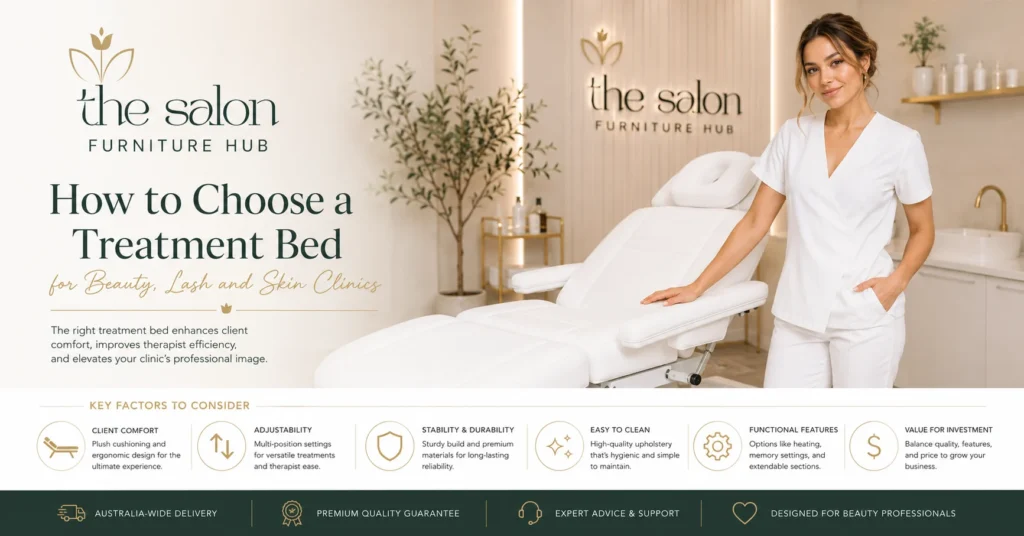
How to Choose a Treatment Bed for Beauty, Lash and Skin Clinics
24
Jun
Jun
Your treatment bed is kind of the centrepiece of every service you deliver, it’s the first thing a client sees when they walk into the room, and it sort of shapes how relaxed they feel for the whole appointment. It also impacts how well you can carry out every technique from your kit. Getting this decision right matters more than a lot of salon owners think, until they’ve already gone and made the wrong call the first time, then it becomes painfully obvious.
The good news is that the Australian market now brings a genuinely strong set of options across every price point, and pretty much all service styles. Whether you’re setting up your first lash room, refreshing a shared beauty setup, or building a high end skin clinic from scratch, there’s a treatment bed out there that should fit your needs just right, even if your idea is a little specific.
This guide goes through the four main types of treatment beds you’ll find in Australia, what services each kind is best at supporting, how to think about floor space and everyday practicality, and also what questions to ask before you spend a dollar. After you finish reading, you should have a clear direction in mind, and not be stuck guessing.
The Four Main Types of Treatment Beds
Before we get into comparisons, it helps to understand what each type of bed actually is and what makes it different.
Fixed Height Treatment Beds
A fixed height bed is pretty much what it sounds like, you know it’s set. The height is arranged during manufacturing or at the first assembly, and then it simply doesn’t change while it’s in use. Usually this is the cheapest option, and it fits clinics quite well where one or two therapists keep working at the same station, or when the treatment itself does not call for much positional shifting.
Fixed beds are often lighter and built in a simpler way, so they get chosen a lot for home based salons and mobile setups, where moving the thing around is sort of a key factor. The downside is ergonomics. If the bed height does not match your working posture, you’ll start to feel it by the end of a long day.
Portable Folding Treatment Beds
Portable beds are meant to fold flat for the moving and storing part, yknow, so they’re easier to cart around. They’re kind of a staple for mobile therapists and also a decent backup plan for clinics when space is tight. Most portable beds sit on an aluminium or timber frame, and then there’s a light weight foam pad on top.
Now, they’re not really built for heavy daily commercial use the exact same way a permanent salon bed is, but for a therapist growing their clientele, or working from multiple locations, they bring real flexibility for a much smaller price.
Hydraulic Lift Treatment Beds
Hydraulic beds kind of use a foot pump mechanism to help raise and lower the bed height. They’re sitting at this mid point between fixed and electric choices, kinda in both price and convenience, too. Basically the therapist works the pump with their foot to lift the bed, then they rely on a release valve to lower it.
One big edge is the height adjustability without any need for power, so they can be placed just about anywhere in a room. No cable routing stress, and you dont have to worry so much about being near power points either. That’s why they are a popular pick for waxing rooms, beauty therapy training environments and even smaller clinics where people want that flexibility ,but without a huge capital outlay.
Electric Treatment Tables
Electric treatment tables use a motor to adjust height at the press of a button. Premium models also offer adjustable backrests, leg sections, and in some cases, memory settings so each therapist in a shared room can recall their preferred working height instantly.
Electric beds are the gold standard for high-volume clinics and skin treatment rooms where therapists are performing long, technically demanding sessions. The ability to adjust height mid-treatment without interrupting the client experience is a genuine quality-of-life improvement for both therapist and client.
When purchasing electric beds in Australia, always confirm the unit is RCM-certified. All electrical furniture at The Salon Furniture Hub is Australian-compliant and RCM-certified, which means it meets local electrical safety standards and will not create issues with your insurers or workplace health and safety obligations.
Quick Comparison: Which Bed Type Suits Your Clinic?
Here is a side-by-side overview to help you narrow down your shortlist before we look at specific service types.
| Feature | Fixed | Portable | Hydraulic | Electric |
| Height adjustable | No | No | Yes (foot pump) | Yes (motor) |
| Power required | No | No | No | Yes |
| Typical price range | $200 to $500 | $100 to $350 | $400 to $900 | $800 to $3,000+ |
| Best for | Home salon, training | Mobile, backup | Waxing, beauty | Skin, medi-beauty |
| Weight capacity | Typically 180 to 250 kg | 100 to 160 kg | 180 to 250 kg | 200 to 300 kg |
| Portability | Low | High | Low to medium | Low |
| Backrest adjustment | Fixed or manual | Manual | Manual | Electric (most models) |
| RCM certification needed | No | No | No | Yes |
| Client comfort level | Good | Moderate | Good to very good | Excellent |
| Ideal room size | Any | Any | 10 sqm+ | 12 sqm+ |
Choosing by Service Type: What Does Your Treatment Menu Need?
The services you offer should drive your bed selection more than anything else. Here is a breakdown by service category.
Lash Extensions and Lash Lifts
Lash technicians spend long stretches working very close to a client’s face, which means client comfort and bed stability are both critical. A client who fidgets because they are uncomfortable will make your job significantly harder.
For lash work, a flat bed with a stable, firm surface is preferred over a deeply cushioned one. You want the client’s head in a predictable position throughout the appointment, which means minimal sink and good head support. A built-in or compatible headrest extension is a strong advantage.
Many lash technicians opt for a dedicated lash bed rather than a general beauty bed, as these are purpose-built with a narrower profile and lower seat height to allow easy access. Fixed height and hydraulic models both work well for lash services.
Browse the Lash Beds range at The Salon Furniture Hub for options built specifically for lash technicians.
Facials, Skin Treatments and Microneedling
Skin services typically involve multiple steps performed over 45 minutes to 90 minutes, including cleansing, exfoliation, extractions, machine treatments, and masking. The therapist is moving around the bed, changing their working angle frequently, and often needs the client to be repositioned.
Electric tables are the preferred choice for skin clinics. The ability to raise and lower the bed mid-treatment without asking the client to shuffle or readjust is a significant experience upgrade, and it protects your back when you are performing multiple sessions back to back.
An adjustable backrest is almost essential for skin work. You will want to recline clients for treatment and bring them upright for consultation and product application without them having to move themselves. Look for models with smooth, quiet motor mechanisms so the experience feels polished.
Waxing and Body Treatments
Waxing beds need to be practical above all else. Easy-to-clean upholstery is non-negotiable, and the bed needs to be sturdy enough that it does not shift or creak when clients are repositioning themselves during body waxing services.
Hydraulic beds are a strong fit for waxing rooms. You can lower the bed for clients to get on and off easily, then raise it to your preferred working height with a few pumps of the foot pedal. This is especially useful in a busy waxing salon where you are moving through clients quickly.
For full-body treatments such as spray tanning, body wraps, or massage-incorporated facials, look for a bed with a wide sleeping surface and ideally an adjustable leg section that allows clients to be comfortable in a supported semi-recline.
Brow Lamination, Tinting and PMU
Brow and PMU services sit somewhere between lash and skin work in terms of what the bed needs to do. You want the client reclined comfortably with their head at a stable, accessible height. Most brow technicians do not need a highly sophisticated table and often work very comfortably with a quality hydraulic or fixed bed paired with a good brow station stool.
The Brow Stations range at The Salon Furniture Hub includes options that pair well with both standard beauty tables and dedicated lash beds.
Massage and Remedial Therapy
If massage is part of your service menu, the bed specifications shift significantly. You need a higher weight capacity, a wider and longer sleeping surface, and ideally a face hole or face cradle attachment for prone-position work. Foam density and padding thickness also matter more for massage than for most other beauty treatments.
Electric tables with adjustable height are highly recommended for massage, particularly if multiple therapists share the same room and have different working heights. A bed set at the wrong height for a massage therapist leads to postural strain very quickly.
Thinking About Space: Room Size and Workflow
A bed that looks perfect online can feel overwhelming in your treatment room if you have not thought through the spatial requirements. Here is what to consider before purchasing.
Standard Treatment Room Dimensions
A standard single-therapist treatment room in an Australian salon or clinic is typically between 9 and 14 square metres. Within that footprint, you need space for the bed itself, clear walking access on at least three sides, your trolley and equipment, and storage.
| Room Size | Bed Type Recommendation | Notes |
| Under 9 sqm | Fixed or portable | Tight but workable with wall-mounted storage |
| 9 to 12 sqm | Fixed or hydraulic | Comfortable for single-service rooms |
| 12 to 16 sqm | Hydraulic or electric | Good workflow for multi-step treatments |
| 16 sqm+ | Electric, wide or multi-section | Suits premium clinic or dual-service room |
| Mobile / home visit | Portable folding bed | Pack-down size and weight are key factors |
Clearance Around the Bed
As a general guide, allow a minimum of 60 centimetres on each side of the bed and 90 centimetres at the foot end. This gives you enough space to walk around during treatment, accommodate a trolley alongside the bed, and ensure clients can get on and off without feeling cramped.
Cable and Power Point Planning for Electric Beds
Electric treatment tables need a power point within reach of the bed’s cable (typically 1.5 to 2 metres). Before purchasing, plan where the bed will sit in your room and confirm the power point location. Running an extension cable across a treatment room floor is a trip hazard and looks unprofessional. If you are fitting out a new room, it is worth having an electrician install a floor-mounted power point in the right location.
Upholstery, Padding and Hygiene
The surface your client lies on matters more than most people give it credit for. Here is what to look for.
PU Leather vs Fabric
Virtually all professional treatment beds sold in Australia today use PU (polyurethane) leather upholstery. It is easy to wipe down between clients, resistant to the oils and serums that inevitably end up on the surface, and durable enough to withstand daily commercial use. Avoid fabric-covered beds in any wet or product-heavy treatment environment.
Foam Density and Comfort
Cheap beds cut corners on foam density. A low-density foam pad will compress quickly and feel noticeably uncomfortable to clients within months. Look for beds with high-resilience foam rated at 40 to 50 kg per cubic metre or above. For massage services, a thicker pad of 6 to 8 centimetres is preferred. For lash work where a firm, stable surface is needed, a slightly firmer, thinner pad is actually better.
Colour and Aesthetic
Your treatment bed should complement your clinic’s interior. Most suppliers offer upholstery in a range of neutral tones such as white, black, cream, grey, and taupe. Some also offer custom colour options if you want your furniture to match a specific brand palette. The Salon Furniture Hub offers custom upholstery options for many of their beauty tables and treatment beds.
Budget Guidance: What Should You Expect to Pay?
Treatment bed pricing in Australia spans a wide range depending on the type, features, and brand. Here is a realistic guide to what you can expect at each price point.
| Budget Range | What You Get | Best For |
| Under $300 | Basic portable or entry-level fixed bed | Home salon, mobile, starting out |
| $300 to $600 | Quality fixed bed, good foam and frame | Lash rooms, beauty rooms, home clinic |
| $600 to $1,000 | Solid hydraulic bed with backrest | Busy wax rooms, beauty therapy |
| $1,000 to $1,800 | Mid-range electric with adjustable back | Skin clinics, multi-service rooms |
| $1,800 to $3,000+ | Premium electric, full section control | Medi-beauty, cosmetic clinics |
Keep in mind that the cost of the bed is only part of your furniture outlay. You will also need a therapist stool, a trolley, adequate lighting, and potentially a headrest extender or bolster set. If you are fitting out a whole room, looking at starter packages can often save you money compared to buying each piece individually.
The Salon Furniture Hub offers Starter Salon Packages and complete Spa Room Fitouts and Lash Room Fitouts if you want everything coordinated and ready to go from a single supplier.
Treatment Bed Buying Checklist
Before you confirm any purchase, run through these questions to make sure you are buying the right bed for your situation.
- What is the primary service I will be performing on this bed?
- Do I need height adjustability for ergonomic reasons or because multiple therapists share the room?
- What is my room size and where will the bed sit in relation to power points and the door?
- What weight capacity do I need?
- Do I need an adjustable backrest, and does it need to be electric or can it be manual?
- What upholstery colour and finish will suit my clinic aesthetic?
- Does the bed need to be portable or will it stay in one location?
- If electric, is it RCM-certified for Australian safety compliance?
- What is my total room budget, including stool, trolley, and accessories?
- Does the supplier offer warranty and replacement parts availability in Australia?
Shop Treatment Beds and Beauty Tables at The Salon Furniture Hub
The Salon Furniture Hub stocks a carefully curated range of treatment beds and beauty tables for Australian clinics, from entry-level lash beds through to premium electric treatment tables. All electrical furniture is RCM-certified and Australian-compliant, with stock held locally for fast delivery across the country.
You can browse the full range of Beauty Tables and Lash Beds online, or contact the team directly if you would like guidance on choosing the right setup for your space. If you are fitting out a whole salon or clinic room, the Business in a Box packages are a smart starting point.
For wholesale enquiries or larger fitout orders, reach out via the Contact Us page to discuss pricing and availability.
Frequently Asked Questions
What is the difference between a beauty bed and a treatment table?
The terms are often used interchangeably in the Australian market. A beauty bed typically refers to a padded, upholstered surface used in beauty therapy settings, while a treatment table may imply a firmer, more clinical surface used in skin clinics or medi-beauty environments. In practice, most modern electric beds sit comfortably in both categories.
Do I need an electric treatment bed or will a hydraulic bed be sufficient?
It depends on your service menu and volume. If you are performing long skin treatments, seeing many clients in a day, or sharing a room with therapists of different heights, electric is worth the investment. For waxing, beauty therapy, and lower-volume lash work, a quality hydraulic bed is more than sufficient and offers better value for money.
What weight capacity should a professional treatment bed have?
For general beauty and lash services, a capacity of 180 kg or above is suitable for most clinics. If you are offering massage, body treatments, or working in a bariatric-friendly environment, look for a capacity of 250 kg or higher. Always check the manufacturer specification before purchasing.
Are electric treatment beds safe to use in Australian salons?
Yes, provided they are RCM-certified. RCM (Regulatory Compliance Mark) certification confirms that the electrical components of the bed meet Australian safety standards. You should always ask for certification documentation when purchasing an electric treatment table. All electric beds available through The Salon Furniture Hub carry this certification.
Can I use a portable massage table for lash extensions?
You can, but it is not ideal. Portable massage tables tend to have softer, deeper padding which can allow a client’s head to sink and shift during the appointment, making lash work more difficult. A dedicated lash bed with a firmer surface and headrest support will give you a much better working experience and a more comfortable, stable position for your client.
What width and length should I look for in a treatment bed?
For general beauty and lash services, a bed width of 60 to 65 centimetres and a length of 185 to 195 centimetres is standard and suits most clients comfortably. For massage or body wrap treatments, a wider surface of 70 to 75 centimetres gives clients more room and improves the overall experience. Always check the total footprint including any headrest extender when planning your room layout.
How do I clean and maintain a treatment bed upholstered in PU leather?
Wipe down the entire surface with a salon-appropriate disinfectant between every client. Avoid using harsh solvents or bleach-based products, which can cause the PU to crack and peel over time. Condition the upholstery monthly with a PU leather cleaner to maintain suppleness and extend the life of the surface. Check the base frame and any moving parts periodically for tightness and lubricate joints on hydraulic models as recommended by the manufacturer.
What accessories do I need with a new treatment bed?
At a minimum, you will need a quality therapist stool, a salon trolley to keep products accessible, and adequate room lighting. Depending on your services, you may also want a headrest extender, bolsters for positioning support, a fitted bed sheet set, and a fitted waterproof cover. Browse the Nail and Lash Stations accessories and Beauty Stools at The Salon Furniture Hub to complete your room setup.
Is there a treatment bed package available for new clinics?
Yes. The Salon Furniture Hub offers complete room packages through the Business in a Box range, which bundles furniture for a full treatment room or salon space. Options include packages tailored for lash rooms, spa rooms, and general salon fitouts. These are a cost-effective way to get everything you need from a single supplier without the hassle of sourcing individual pieces.
| Ready to Set Up Your Treatment Room? Browse the full range of beauty tables, lash beds, electric treatment tables and room packages at The Salon Furniture Hub. All electrical furniture is RCM-certified and Australian-compliant, with fast shipping nationwide. Shop Beauty Tables | Shop Lash Beds | Room Packages | Contact Us |